How Water-Based Cooling Works
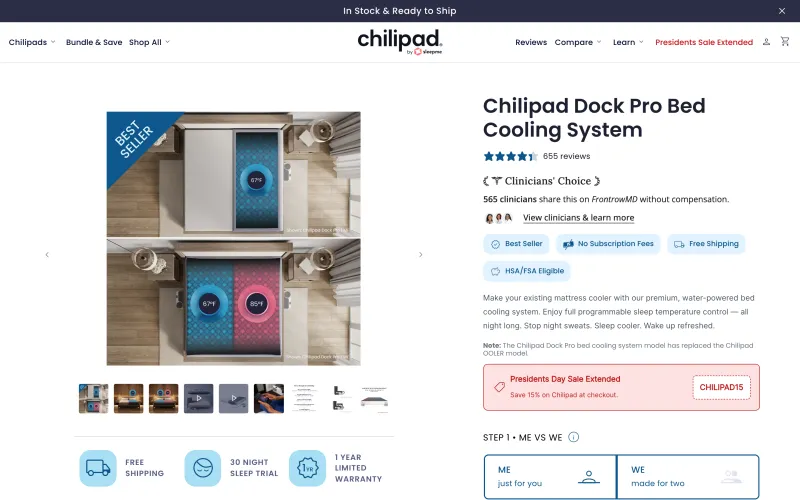
Water-based systems like Eight Sleep and ChiliPad use a simple but effective principle: a control unit chills water (or a water-glycol mix) and pumps it through a thin pad that sits on top of your mattress, under your sheets. The pad contains a network of micro-tubes; as water circulates, it absorbs body heat and carries it away.
The Physics
Water has a specific heat capacity roughly four times higher than air — meaning it can absorb and transport more thermal energy per unit volume. That's why water-based systems can achieve surface temperatures as low as 55°F, while air-based systems are limited by the ambient air they're pulling from (typically 66°F minimum).
The pad makes direct contact with your body (through a thin sheet layer), so heat transfer is conductive — highly efficient. The cooling sensation is immediate and consistent across the entire sleep surface.
How Air-Based Cooling Works
BedJet takes a different approach: a compact unit sits at the foot of your bed and blows air through a hose that feeds under your sheets. The air is either ambient room temperature or slightly cooled. BedJet's "biorhythmic cooling" focuses on evaporative cooling — moving air across your skin to accelerate sweat evaporation, which is your body's natural cooling mechanism.
The Physics
Air-based cooling doesn't conduct heat away; it convects it. Moving air accelerates evaporation, and evaporation requires energy (latent heat), which your body supplies. The effect is real but less intense than direct conductive cooling. BedJet's range is 66°F–104°F — it can warm you in winter but can't match water systems for raw cooling power.
Noise Comparison
Water systems use a pump and sometimes a small compressor or thermoelectric cooler. Eight Sleep runs at under 30 dB — effectively whisper-quiet. ChiliPad's Dock Pro is louder at 50–55 dB, comparable to a quiet conversation. Light sleepers report noticing it during initial ramp-up.
BedJet uses a fan; at full blast it reaches ~43 dB. At lower settings it's quieter. The key difference: BedJet's noise is a steady whoosh, while water pumps can have a subtle hum. Many users find BedJet's white-noise quality less disruptive than ChiliPad's mechanical sound.
Maintenance Requirements
- Eight Sleep: Minimal. Refill water every 2–4 weeks. Occasional descaling. Pad is not user-washable; spot-clean only.
- ChiliPad: Refill every 1–2 weeks. Monthly cleaning cycle. Pad is machine-washable — a significant advantage for hygiene.
- BedJet: Quarterly filter cleaning. No water, no pumps. Lowest maintenance of the three.
Temperature Range: The Bottom Line
If you need to sleep in a 55°F environment — you run extremely hot, live in a warm climate without AC, or have a medical condition — water-based is the only option. If you're a moderate hot sleeper and 66°F is cool enough, BedJet saves you money and maintenance. For most people, water-based systems deliver a more dramatic cooling sensation; air-based is "good enough" at a fraction of the cost.